Concrete Slab Installation San Diego CA
Concrete Slab Installation San Diego CA is what we do every week, from garage floors in Clairemont to patio slabs in La Jolla. Our San Diego concrete slab contractor crew handles the grading, rebar, formwork and pour, so you get a slab that stays flat and crack-free for decades instead of settling two winters from now.
Service overview
Concrete Slab Installation San Diego CA done right
Concrete Slab Installation San Diego CA is the process of grading a base, building forms, setting rebar or wire mesh, pouring a mixed concrete batch and finishing it to a flat, durable surface. A slab is only as good as what sits under it, so we compact the subgrade, add a gravel base where the soil calls for it, and control moisture before a single yard of concrete shows up. Thickness runs 4 inches for patios and walkways, 5 to 6 inches for driveways and garage floors, and 8 inches or more when the slab carries a structure. San Diego homeowners call us for a new concrete slab San Diego CA for a lot of reasons: an old slab has cracked and sunk, an addition needs a foundation, or a backyard needs a flat patio that does not turn into a mud pit every winter. Our coastal soil, from the sandy bluffs of Point Loma to the clay-heavy ground in Poway, behaves differently from inland desert dirt, and slabs poured without that in mind tend to settle, spall or crack within a few years. If you have been searching for concrete slab installation San Diego CA near me, we can walk the site and tell you exactly what your ground needs.
! Problems we solve
Slab has cracked and the pieces are moving apart
Water gets under the slab, the base erodes, and the crack widens every season until the slab is unsafe to walk or park on.
Slab has settled and now ponds water
Standing water against a foundation or garage wall causes moisture damage, and a sunken slab is a trip hazard on walkways and patios.
Surface is spalling and flaking off
Spalling leaves a rough, ugly surface that gets worse with every freeze-thaw cycle and every round of salt air, and it exposes the aggregate underneath.
Scope of work
What our slab installation service includes
Every slab we pour comes with the same core scope: excavation, base prep, forms, reinforcement, the concrete itself, finishing, control joints, curing and cleanup. What changes from job to job is thickness, reinforcement density, finish and whether the slab needs a vapor barrier or a permit.
-
01
Excavation and haul-off
We strip sod, dig to the right depth for your slab thickness, and haul the spoils away. If there is an old slab in the way, we break it out with a concrete saw and a breaker, load it, and dispose of it so you are not left with a pile of rubble in the yard.
-
02
Compacted base and grading
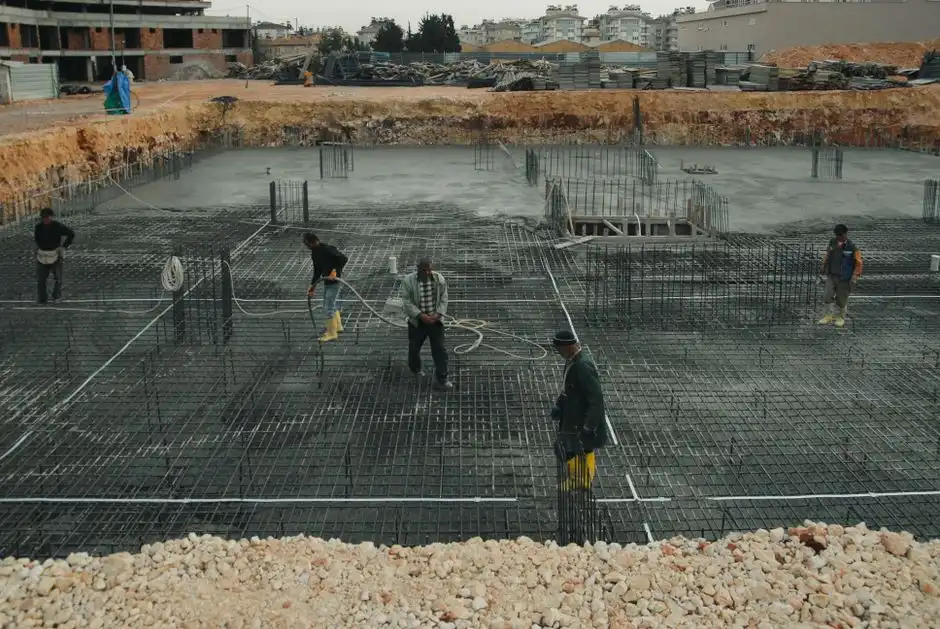
We bring in and compact a gravel or crushed base in 2 to 3 inch lifts, then check the grade with a laser level. This is what stops a slab from settling unevenly. On clay-heavy ground we go deeper, and on sandy coastal ground we adjust the base to match.
-
03
Forms, rebar and vapor barrier
We set forms to the finished elevation and slope, then tie rebar or lay wire mesh on chairs so the steel sits at mid-slab height. Interior slabs and garage floors get a 6 mil vapor barrier underneath to stop moisture from wicking up through the concrete.
-
04
Pour, finish and control joints
We place the concrete in one continuous pour, screed it flat, consolidate it with a vibrator, and finish it with a broom, power trowel, stamp or exposed aggregate. Then we cut control joints with a concrete saw and apply curing compound so the slab cures at the right rate.
Why a properly poured slab matters
A slab is the one part of a project you never want to redo. Here is what a correctly built slab gives you, and what shortcuts cost you later.
Request an estimateTools and methods we use on slab work
Concrete mixer and pump truck
We use a mixer for smaller pours and a boom or line pump for backyard slabs with no truck access. The pump keeps the pour continuous so there are no cold joints in the finished slab.
Laser level and screed
A laser level sets the finished elevation and slope before we pour, and a screed strikes the concrete flat across the forms. Together they keep the slab within a quarter inch across the whole surface.
Bull float and power trowel
The bull float pushes down the aggregate and brings up the cream right after the pour. A power trowel then works the surface to a hard, smooth finish on garage floors and interior slabs.
Concrete saw and groover
We use a groover on fresh concrete for small joints, and a concrete saw the next morning to cut control joints to depth. Those joints are what tell the slab where to crack so the surface stays intact.
Local execution
San Diego is not one soil type, and that changes how we build a slab. Coastal neighborhoods like Pacific Beach and Ocean Beach sit on sandy, fast-draining ground that compacts differently from the clay-heavy soil in El Cajon and Poway. Hillside lots in La Mesa and Encinitas often have fill dirt that was placed decades ago and never properly compacted, so we dig deeper and use more base. Inland valleys like Escondido and San Marcos see bigger swings between hot days and cool nights, which puts more stress on a slab and makes control joint layout more important. We also deal with salt air near the coast, which speeds up spalling on slabs that are not sealed. Our concrete slab pouring San Diego crews adjust the mix, the base depth and the reinforcement to match what the ground is actually doing. If you want the best concrete slab installation in San Diego, the answer is not a thicker slab, it is a slab built for your specific site. We pull permits when the city or county requires one, and we schedule inspections around your timeline.
How slab work runs in San Diego
- • Mission Valley
- • La Jolla
- • Poway
- • Chula Vista
Recent work
Available 24/7 for slab work in San Diego
When you call, a real person answers
We answer the phone 24/7, and if you call after hours about a slab that has cracked or a pour that needs to happen fast, we will get back to you the same night. Our crews run 2 to 4 people on a typical residential slab, and we keep the trucks stocked with rebar, wire mesh, form release agent, expansion joint material and curing compound so we are not making supply runs mid-job. For bigger pours we schedule a concrete mixer or pump truck in advance and confirm the batch the day before. Most estimates get scheduled within 2 to 3 days of your call, and we can often get a crew on site within a week for standard patio and garage slab work. If you need concrete slab pouring San Diego CA open now, call us and we will tell you honestly what we can do and when.
How our slab installation process works
Site walk and layout
We come out, measure the area, check the soil and look at how water moves across the site. You get a written scope with thickness, reinforcement and finish spelled out. Most estimates take 30 to 45 minutes on site, and we can usually get out within a few days of your call.
Excavation and grading
We strip sod, remove old concrete if needed, and dig down 4 to 8 inches depending on slab thickness and base requirements. Then we grade and compact the subgrade in 2 to 3 inch lifts so the base does not settle after the pour. This is the step most fly-by-night crews skip.
Forms, rebar and vapor barrier
We set wood or steel forms to the finished elevation, then tie a grid of rebar on chairs or lay wire mesh. For interior slabs and garage floors we roll out a 6 mil vapor barrier to stop moisture from wicking up through the concrete. Everything gets checked against the laser level before we pour.
What slab installation costs in San Diego
Slab pricing in San Diego in 2026 runs $8 to $16 per square foot for most residential work, depending on thickness, reinforcement, base prep and finish. A simple 4 inch patio with a broom finish sits at the lower end, while a 6 inch garage floor with a vapor barrier, dense rebar and a power-troweled finish sits at the higher end. Excavation, hauling, access for the truck and whether the job needs a permit all move the number. We give you a written range after we see the site, and the price we agree to is the price you pay.
Slab thickness and reinforcement
A 4 inch patio slab uses less concrete and lighter steel than a 6 inch garage floor or driveway. Thicker slabs need more rebar, more chairs and more concrete, which is the single biggest driver of cost. Structural slabs with footings run higher still.
Excavation and base prep
If the ground is easy to dig and drains well, base prep is straightforward. If we hit rock, old concrete, or clay that needs a deeper base, the excavation and haul-off costs go up. Removing an existing slab adds demo and disposal to the job.
Finish and access
A broom finish is the standard and the least expensive. Stamped, colored or exposed aggregate finishes add material and labor. If the truck cannot reach the pour area, we bring in a concrete pump, which adds cost but keeps the pour continuous.
Licensed, certified and reviewed
Concrete slab questions, answered
How much does concrete slab installation cost in San Diego CA?
Most residential slabs in San Diego run $8 to $16 per square foot in 2026, so a 400 square foot patio lands around $3,200 to $6,400. Garage floors and driveways sit at the higher end because they need thicker concrete and more steel. Excavation, hauling, base material and finish choice all move the number, and we give you a written range after we see the site.
How long does concrete slab pouring take in San Diego?
A typical patio or garage slab takes 1 to 2 days on site for excavation, forms and steel, then a single pour day of 2 to 5 hours depending on size. The slab then cures for 7 days before foot traffic, and 28 days before it reaches full design strength. We cut control joints within 24 hours of the pour.
Who is the best concrete slab contractor in San Diego California?
The right contractor is the one who shows you a written scope, explains base prep and reinforcement, holds a California Contractor License (CSLB), and stands behind the work. Ask any crew what thickness they plan, how they hold rebar at mid-slab height, and what happens if the slab cracks. We answer those questions on every estimate, and we carry a 5-year workmanship warranty.
Do I need a permit for slab installation in San Diego?
A flat patio or walkway slab on grade usually does not need a permit in the City of San Diego. A slab that carries a structure, an addition, a detached garage or a retaining wall above 4 feet does. We tell you during the estimate whether your project needs one, and we can pull it and schedule the inspection for you.
Related services
Concrete Driveway Installation
A driveway is a slab, just thicker and built for vehicle weight. We pour 5 to 6 inch driveways with heavier rebar and a broom finish for traction, and we tie the apron into the street grade so water runs off instead of pooling at the garage door.
Concrete Patio Installation
Patio slabs are the most common pour we do in San Diego. We set the forms to slope away from the house, add control joints on a 8 to 10 foot grid, and finish with broom, stamped or exposed aggregate depending on the look you want.
Get your Concrete Slab Installation San Diego CA estimate
We have been pouring slabs in San Diego County since 2019, and every job comes with a written scope and a 5-year workmanship warranty. Call us, tell us what you need poured, and we will get out to look at the site and give you a real number.